

Chronic Achilles Pain? How Boulder Athletes Are Finally Seeing Results with Shockwave Therapy
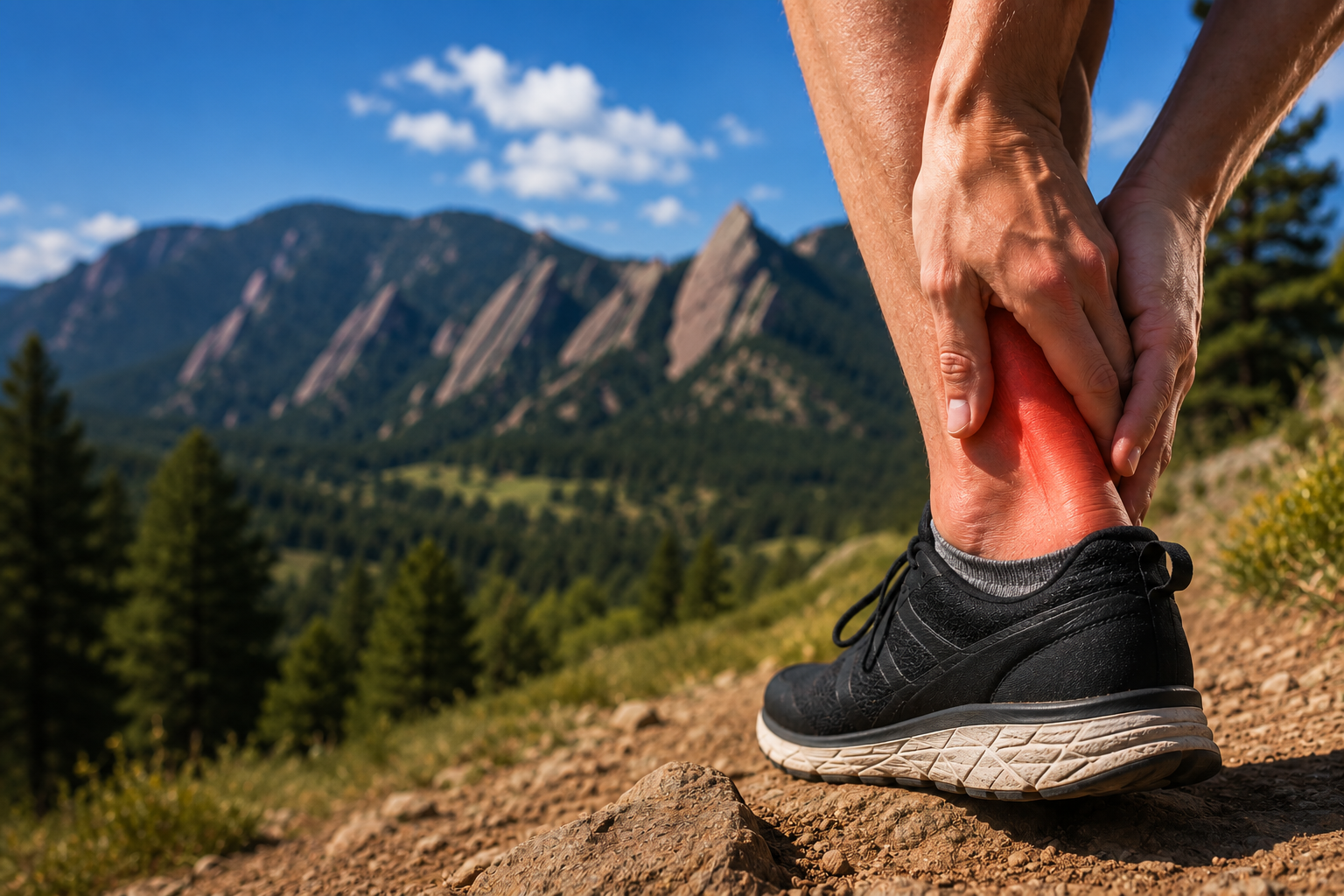
When every hike, run, or walk around the neighborhood with your dogs starts and ends with pain, it's easy to wonder if your Achilles tendon will ever feel normal again. Chronic Achilles pain has a way of lingering for months (or even years), and it doesn't just affect elite runners. It can impact hikers, climbers, pickleball players, and anyone who enjoys staying active. If you've been struggling with an Achilles injury for a long time, you've likely tried stretching, endless repetitions of calf raises, rest, or new shoes with only minimal relief. While those strategies may help temporarily, they may not fully stimulate the deep healing your tissues need. Thus, Extracorporeal Shockwave Therapy (ESWT) has emerged as one of the most effective, evidence-based treatments for chronic Achilles tendon injuries, especially when combined with other rehabilitative modalities (i.e. physical therapy, strengthening, dry needling, etc.). This blog explains why Achilles tendinopathy develops, the science behind shockwave therapy as a treatment for chronic cases, results you can expect, and whether it's the right option for you and your return to an active lifestyle.
What Is Achilles Tendinopathy?
Achilles tendinopathy is an overuse injury that develops when the Achilles tendon is repeatedly loaded beyond its ability to recover. Rather than being just an inflammatory condition, chronic Achilles tendinopathy involves degeneration and poor healing of the tendon tissue, leading to reduced tendon stiffness and an impaired capacity for high impact loads (1).
Common contributing factors to developing Achilles tendinopathy include (2):
Rapid increases in running mileage, hiking volume, or high impact activity (i.e. pickleball, jumping, etc.)
Steep trail running and hill repeats
Limited ankle and toe mobility
Calf weakness (and of course, glute weakness…)
Training through persistent pain
These types of injuries can be easy to spot, as the hallmark symptom is pain and stiffness near the back of the heel or middle of the tendon, particularly during the first steps in the morning or at the beginning and end of a run. Symptoms often improve as you warm up, only to return or worsen afterward or the following day.
Why Boulder Runners Are Especially Prone to Achilles Injuries
Trail running in Boulder brings a magical experience of enjoying mother nature while moving your body in new and unique ways. However, trail running places very specific demands on the Achilles tendon. Compared to flat road running, steep uphill climbing requires significantly greater calf muscle force, while downhill running places higher eccentric loads on the tendon. Add altitude, technical terrain, and year-round participation, and it's easy to understand why Achilles tendinopathy is one of the most common injuries seen in endurance athletes.
It can be difficult to understand these injuries in the beginning, especially when pain is mild and goes away within a few minutes of running or a few moments out of bed in the morning. For some, taking a few days of rest resolves the issue. Yet, for most, pain and stiffness often return, becoming more pronounced and frequent over time. Remember that for any injury, ignoring symptoms rarely works. Continuing to "push through it" - even when mild - often leads to worsening tendon degeneration and longer recovery times down the road. Early evaluation and treatment generally leads to better outcomes and a faster return to doing what you love.
Treatment for Achilles Tendinopathy
Successful Achilles tendinopathy treatment should address both tendon tissue healing as well as the mechanical or lifestyle factors contributing to overload. Scientific research consistently supports progressive loading exercises as the foundation of treatment for long term recovery (3). However, for chronic cases or in situations where exercises weren’t enough, focused shockwave therapy has emerged as an effective addition to a comprehensive rehabilitative program (4). Unlike cortisone injections or surgery, shockwave therapy is completely non-invasive, as high-energy acoustic waves are delivered directly to the injured tendon to stimulate an immediate biological healing response.
Why consider shockwave therapy? Current evidence suggests shockwave therapy may (5):
Stimulate new blood vessel formation
Improve cellular repair activity
Reduce pain sensitivity
Promote tendon tissue remodeling
Improve overall tendon function when combined with progressive loading exercises
When considering stubborn, chronic injuries, combining shockwave therapy with traditional physical therapy exercises continues to be proven as a superior treatment approach for achilles tendinopathy (5).
Shockwave Therapy for Achilles Tendinopathy: What Does the Research Show?
One of the most common questions we hear is whether the evidence actually supports shockwave therapy as an effective treatment for achilles tendinopathy. The short answer is yes, and particularly for chronic cases. A systematic review in The American Journal of Sports Medicine published in 2015 found evidence supporting the effectiveness of shockwave therapy for treating chronic Achilles tendinopathy, and that results were further enhanced when shockwave was combined with an evidence-based exercise program (5). More recently, the 2018 Clinical Practice Guideline from the Orthopaedic Section of the American Physical Therapy Association recommends considering shockwave therapy alongside progressive tendon loading for patients who continue to experience Achilles tendon pain despite trying exercise alone (3). Many patients experience improvements in symptoms during 3 - 6 sessions of treatment, with tendon remodeling continuing for several months even after shockwave treatment is complete (6).
Shockwave vs. PRP for Achilles Tendinopathy
There are a plethora of modalities out there that are effective in treating Achilles tendinopathy, and patients frequently ask specifically about shockwave vs. PRP injections. Platelet-rich plasma (PRP) injections attempt to stimulate healing in the tissue using concentrated platelets drawn from your own blood. While PRP has shown promise in some tendon conditions, research on Achilles tendinopathy remains mixed, with several high-quality studies finding little advantage over placebo (7,8).
Shockwave therapy offers several advantages:
Completely non-invasive
No needles or injections
Minimal downtime (often weeks of no or modified activity after PRP)
No need to stop most daily activities
Supported by multiple clinical guidelines for chronic tendinopathy
For many patients, shockwave therapy is an excellent, safe, effective option before considering more invasive and costly procedures.
What to Expect at Boulder Sports Physiotherapy
At Boulder Sports Physiotherapy, shockwave therapy is rarely used as a standalone treatment. Your first appointment includes a comprehensive movement assessment to identify why your tendon became overloaded in the first place. Then, we identify if shockwave therapy is an appropriate treatment modality for your specific injury. In addition, your rehab program may include:
Progressive Achilles loading exercises
Running gait analysis
Hip and core strengthening
Ankle mobility work
Return-to-running progression
Education on training load management, shoewear, etc.
Most patients receive 3-6 shockwave treatments, spaced approximately one week apart, while continuing their individualized rehabilitation program and ideally some amount of training - whether running or mixed with cross training.
Ready to Get Back on Your Feet?
If you've been struggling with chronic Achilles pain and haven't found lasting relief, you don't have to keep guessing. At Boulder Sports Physiotherapy, we specialize in helping active adults and athletes overcome persistent tendon injuries using individualized physical therapy and focused shockwave therapy supported by the latest scientific research. Schedule an initial evaluation today, which includes your first treatment and exercise program so you don’t have to waste any more time being stuck in your injury. We can’t wait to help you get back to running, hiking, climbing, and doing all the activities you love, without hearing a peep from your Achilles tendon.
Frequently Asked Questions
1) Is shockwave therapy painful?
Most patients describe the treatment as mildly uncomfortable but very tolerable. The intensity is adjusted throughout the session based on your comfort level, and there is typically minimal soreness afterwards.
2) How many shockwave treatments do I need?
Most chronic Achilles cases respond well to 3-5 sessions of shockwave therapy, although the exact number depends on symptom duration, tendon health, and frequency of appointments.
3) Can I continue running?
Short answer - it depends. Many athletes can continue some running or modified training while symptoms improve, but this depends on pain levels, tendon irritability, and training goals. Your physical therapist will help determine appropriate activity modifications.
4) Is surgery usually necessary?
Fortunately, most individuals with Achilles tendinopathy improve without surgery, especially if they are treated with progressive loading, activity modification, and evidence-based interventions like shockwave therapy.
References
Cook, J. L., & Purdam, C. R. (2009). Is tendon pathology a continuum? A pathology model to explain the clinical presentation of load-induced tendinopathy. British Journal of Sports Medicine, 43(6), 409-416.
Magnan, B., Bondi, M., Pierantoni, S., & Samaila, E. (2014). The pathogenesis of Achilles tendinopathy: a systematic review. Foot and Ankle Surgery, 20(3), 154-159.
Martin, R. L., Chimenti, R., Cuddeford, T., Houck, J., Matheson, J. W., McDonough, C. M., ... Carcia, C. R. (2018). Achilles pain, stiffness, and muscle power deficits: Midportion Achilles tendinopathy revision 2018 clinical practice guideline. Journal of Orthopaedic & Sports Physical Therapy, 48(5), A1-A38.
Sussmilch-Leitch, S. P., Collins, N. J., Bialocerkowski, A. E., Warden, S. J., & Crossley, K. M. (2012). Physical therapies for Achilles tendinopathy: systematic review and meta-analysis. Journal of foot and ankle research, 5(1), 15.
Mani-Babu, S., Morrissey, D., Waugh, C., Screen, H., & Barton, C. (2015). The effectiveness of extracorporeal shock wave therapy in lower limb tendinopathy: A systematic review. American Journal of Sports Medicine, 43(3), 752-761.
Stania, M., Juras, G., Chmielewska, D., Polak, A., Kucio, C., & Król, P. (2019). Extracorporeal Shock Wave Therapy for Achilles Tendinopathy. BioMed research international, 2019, 3086910. https://doi.org/10.1155/2019/3086910
de Vos, R. J., Weir, A., van Schie, H. T. M., Bierma-Zeinstra, S. M. A., Verhaar, J. A. N., Weinans, H., Tol, J. L. (2010). Platelet-rich plasma injection for chronic Achilles tendinopathy: A randomized controlled trial. JAMA, 303(2), 144-149.
Zhang, Y. J., Xu, S. Z., Gu, P. C., Du, J. Y., Cai, Y. Z., Zhang, C., & Lin, X. J. (2018). Is platelet-rich plasma injection effective for chronic Achilles tendinopathy? A meta-analysis. Clinical Orthopaedics and Related Research®, 476(8), 1633-1641.