

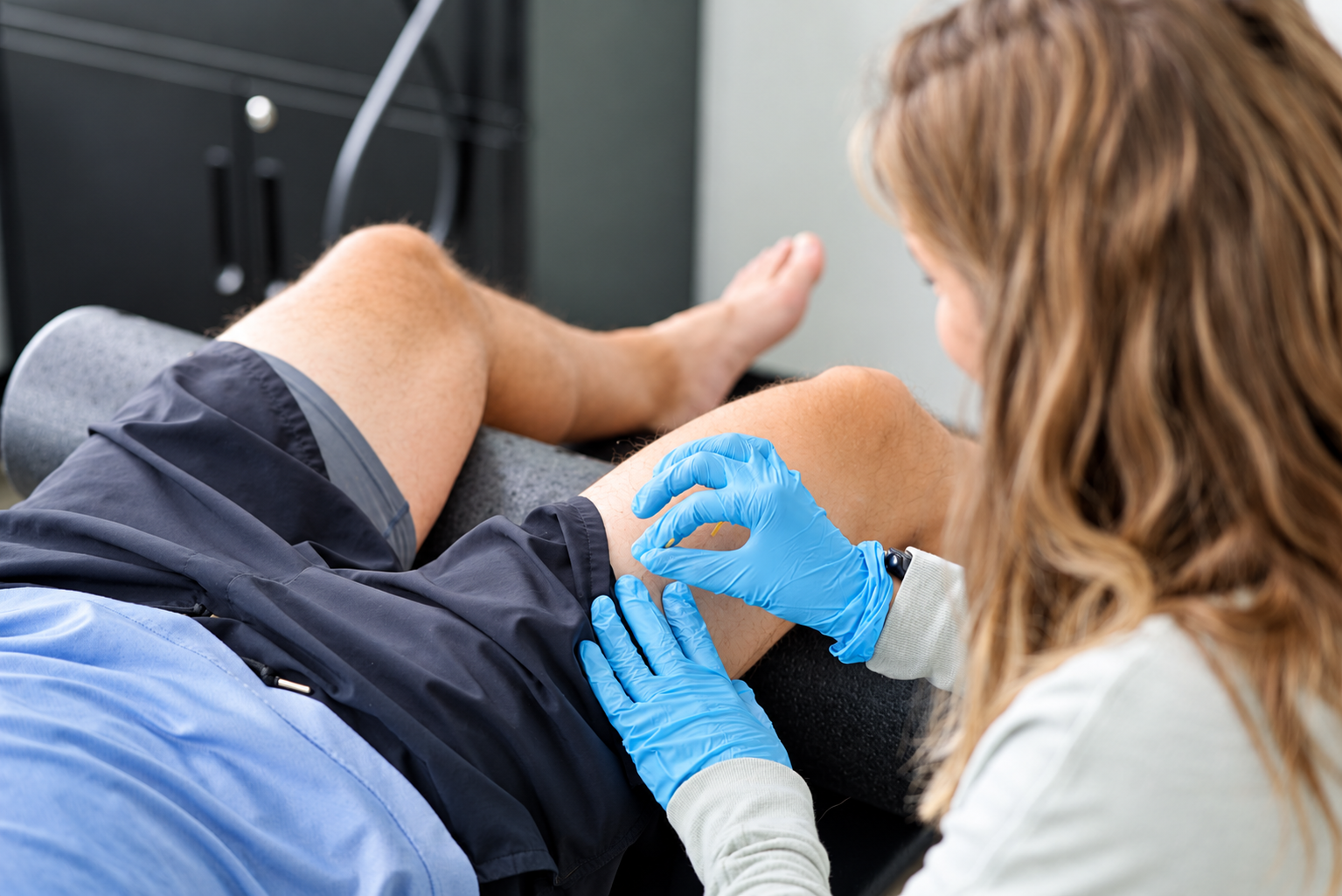
Your knee has been grumbling since your last long run, and you've decided it's time to see a physical therapist. Great call.
Now comes the next question: should you use your insurance, or go to a cash-pay clinic?
Both are good paths to getting better. They just work a little differently. Here's what to know so you can choose the one that fits you best.
How Insurance-Based Physical Therapy Works
At an insurance-based clinic, the clinic bills your insurance plan directly. You pay your share through your deductible, copays, or coinsurance, and your plan covers the rest.
Your care follows a plan of care tied to your diagnosis, and your plan may set a number of covered visits or require prior authorization. Your clinic's front desk usually handles those details for you.
Insurance-based PT is a great fit for many people, especially if you've met your deductible or have a low copay.
How Cash-Pay Physical Therapy Works
At a cash-pay clinic, you pay the clinic directly for each visit. That simple setup opens up some options that are hard to fit into an insurance model.
Your session can follow how you feel that day. You came in for your Achilles, but your hip is the cranky one after the weekend? We can shift focus on the spot. Your care adapts to you, visit by visit.
Maintenance sessions are an option. Once you're feeling good, you can keep checking in during a big training block to stay ahead of small problems before they become big ones.
Needling-only sessions fit around training. Many runners and cyclists book dry needling sessions as they build mileage and push toward race day. Come in, get needled, get back to training.
You get more time. Cash-pay clinics often build in longer, one-on-one sessions.
Pricing is clear. You know what each visit costs before you book.
Who Treats You: DPT, PTA, or Aide?
Many clinics use a team approach, and every role plays a part:
Physical therapists hold a Doctor of Physical Therapy (DPT) degree and are licensed to evaluate, diagnose, and design your treatment plan (3).
Physical therapist assistants (PTAs) typically complete an associate's degree from an accredited program and hold a license or certification (4). They carry out treatment under a PT's direction.
Physical therapy aides usually have a high school diploma or equivalent and on-the-job training (4). They often help set up equipment and guide exercises.
At Boulder Sports Physiotherapy, every minute of every session is spent with a Doctor of Physical Therapy.
What About Shockwave Therapy?
Focused shockwave therapy is one of the most effective tools we have for stubborn tendon problems like plantar fasciitis and Achilles tendinopathy.
Shockwave usually isn't covered by insurance for sports injuries, so it's typically an out-of-pocket service wherever you get it. At a cash-pay clinic, it fits right into your session alongside the rest of your care.
Can Cash-Pay PT Save You Money?
Often, yes. This is the part that surprises people.
Most plans have a deductible, which is the amount you pay before insurance starts sharing costs. In 2025, the average deductible for single employer coverage was $1,886, and 34% of covered workers had a deductible of $2,000 or more (1). If you haven't met yours yet, you're typically covering the cost of your visits yourself either way.
That's why it helps to compare the total cost of your care rather than the price of a single visit. When each session is longer, some patients need fewer visits overall.
You can also generally use HSA or FSA funds for physical therapy (2).
If You Have Medicare
Medicare has its own rules for physical therapy, and they're worth knowing.
Some physicians can opt out of Medicare and see Medicare patients on a private-pay basis. Physical therapists aren't eligible to opt out (5). Because of that, a PT who isn't enrolled with Medicare generally can't provide Medicare-covered services to Medicare beneficiaries.
The good news: cash-pay clinics can still treat Medicare patients for services Medicare doesn't cover. At Boulder Sports Physiotherapy, that includes wellness sessions, dry needling, and shockwave therapy.
If you have Medicare, give us a call before booking. We'll talk through your goals and help you find the best fit, whether that's with us or with one of the great Medicare-enrolled clinics in Boulder.
When Insurance-Based PT May Be the Better Fit
Insurance-based PT can be a great choice if:
You've already met your deductible and have a low copay
You're planning longer post-surgical rehab with many weeks of visits
Your care is covered by workers' compensation or an auto claim
You need Medicare-covered physical therapy
Questions to Ask When Choosing a Physical Therapy Clinic in Boulder
Wherever you go, these questions help you know what to expect:
How long is each session?
Will I work with a DPT, a PTA, or an aide?
Can we work on a different area if something else is bothering me that day?
What will my care cost in total?
Cash-Pay Physical Therapy at Boulder Sports Physiotherapy
Every visit at BSP is one-on-one with a Doctor of Physical Therapy. You can book a 30, 60, or 90 minute session depending on what you need that day, whether that's a full evaluation, a maintenance check-in, a needling session mid-training block, or shockwave for a stubborn tendon.
You don't need a referral to book.
Have out-of-network benefits? BSP provides superbills you can submit to your insurance company. Depending on your plan, those visits may be reimbursed or count toward your out-of-network deductible, so your cash-pay visits can still help you reach your plan's cost-sharing thresholds. Check with your insurance company to see how your plan handles out-of-network physical therapy.
Pricing is listed when you book online.
Find the Path That Gets You Moving
The best physical therapy is the kind that gets you back to the trails, the bike, or the wall. If flexible session lengths, one-on-one time with a DPT, and straightforward pricing sound like your style, we'd love to meet you.
Ready to get back to running, riding, or climbing? Book your evaluation with Boulder Sports Physiotherapy.
Sources
KFF. 2025 Employer Health Benefits Survey. San Francisco, CA: KFF; 2025.
Internal Revenue Service. Publication 502: Medical and Dental Expenses.
U.S. Bureau of Labor Statistics. Occupational Outlook Handbook: Physical Therapists.
U.S. Bureau of Labor Statistics. Occupational Outlook Handbook: Physical Therapist Assistants and Aides.
Code of Federal Regulations, 42 CFR §405.400 (Medicare private contracts: definitions).